Like the storied Māori warriors who once protected their lands, today’s pest control Hastings specialists in New Zealand face a vital battle against invasive species. You’ll find that our island nation’s unique ecosystem demands specialized approaches that go far beyond conventional pest management.
While New Zealand’s unique ecosystem faces challenges from both native and introduced pests, the country has developed extensive pest control strategies that prioritize environmental protection.

The pest control methods you’ll encounter focus on targeting invasive species like possums, stoats, and rats that threaten native birds such as kiwi and kakapo.
DOC’s approach combines traditional techniques with innovative solutions, including predator-proof fencing and community-led initiatives like Predator Free 2050.
You must follow strict guidelines when implementing pest control measures, ensuring compliance with the Hazardous Substances and New Organisms Act 1996 and consulting local iwi for cultural considerations.
For effective pest control in New Zealand, you’ll need to understand several distinct approaches and methodologies that work together as an integrated system.
The main sections you’ll encounter include chemical control, biological control, physical barriers, and cultural control methods.
Chemical control involves targeted pesticides and toxins like sodium fluoroacetate (1080), while biological control utilizes natural predators and pathogens specific to New Zealand pests.
Physical barriers encompass trapping systems, exclusion fencing, and bait stations designed for local species like possums and stoats.
Cultural control focuses on environmental modification, including vegetation management and sanctuary creation.
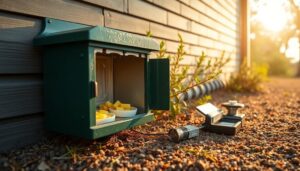
You’ll also need to understand monitoring techniques, compliance with the Resource Management Act 1991, and DOC guidelines for implementing these control methods in New Zealand’s unique ecosystem.
Professional photography plays an essential role in documenting New Zealand’s pest control efforts, requiring high-resolution images that capture both the devastating impact of invasive species and the successful intervention methods.
You’ll need National Geographic-quality photographs showing possums stripping native trees, stoats preying on kiwi chicks, and rats devastating bird populations. Close-up shots should display the precision of trap mechanisms and bait stations, while aerial imagery can showcase large-scale pest control operations across diverse landscapes.
For conservation impact, you’ll want dramatic before-and-after sequences highlighting forest regeneration and the return of native species.
Ascertain photographers use telephoto lenses for wildlife safety and follow strict biosecurity protocols. Include infrared trail camera footage to document nocturnal pest behavior and control effectiveness.
New Zealand’s extensive pest control program stands as one of the world’s most ambitious conservation initiatives, targeting multiple invasive species that threaten the country’s unique biodiversity.
You’ll find that the country employs a thorough approach, combining aerial and ground-based methods to control pests like possums, rats, and mice.
The Department of Conservation’s primary tool is aerial 1080 drops, which you can see deployed across remote areas where ground access is limited.
They’re complemented by ground-based trapping networks and bait stations that you’ll notice along hiking trails and in accessible forest areas.
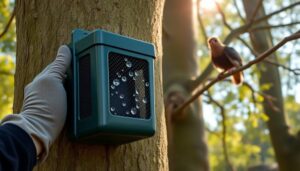
You’ll discover that these methods work together with advanced monitoring systems, including tracking tunnels and motion-sensor cameras, to guarantee the effectiveness of pest control operations while protecting native species.
As a certified pest control technician operating in New Zealand’s diverse ecosystems, I’ve implemented thorough control strategies that balance ecological preservation with effective pest management.
I regularly deploy integrated pest management (IPM) techniques, combining biological controls like predator species with targeted chemical applications when necessary. You’ll find me using species-specific baits for possums and rodents, while implementing exclusion methods for birds and larger pests.
I always consider the native wildlife when selecting control methods. We use DOC-approved traps and guarantee all pesticides meet strict environmental guidelines.
My work often involves coordinating with local conservation groups to protect endangered species while eliminating invasive ones. Regular monitoring and data collection help me adjust strategies for maximum effectiveness with minimal environmental impact.